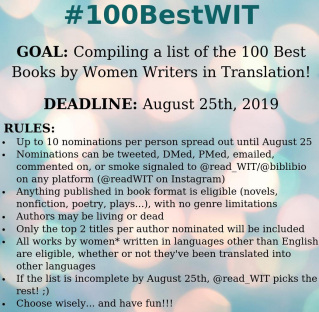
#100bestWiT

100 Best Women Writers in Translation

Dropping in just ahead of the deadline to post my top ten (so far) – here they are!

  1. Iran: Disoriental by Négar Djavadi (tr. Tina Kover)
  2. Equatorial Guinea: La Bastarda by Trifonia Melibea Obono (tr. Lawrence Schimel)
  3. Spain (Catalan): Brother in Ice by Alicia Kopf (tr. Mara Faye Letham)
  4. India: Abandon by Sangeeta Bandyopadhyay (tr. Arunava Sinha)
  5. Colombia: Fish Soup by Margarita García Robayo (tr. Charlotte Coombe)
  6. Côte d’Ivoire: Aya de Yopougon by Marguerite Abouet & Clément Oubrerie (tr. Helge Dascher)
  7. Argentina: Feebleminded by Ariana Harwicz (tr. Annie McDermott & Carolina Orloff)
  8. Vietnam: Paradise of the Blind by Duong Thu Huong (tr. Phan Huy Duong & Nina McPherson)
  9. Latvia: Soviet Milk by Nora Ikstena (tr. Margita Gailitis)
  10. Hungary: The Door by Magda Szabó (tr. Len Rix)

The Wind That Lays Waste by Selva Almada (tr. Chris Andrews)

The Wind That Lays Waste

a nutshell: this highly charged, palpable prose is ignited by the sparks thrown off a heady encounter between a preacher, his daughter, a mechanic and his assistant in the wilds of northern Argentina

a line: “But Leni has no lost paradise to revisit. Her childhood was very recent but her memory of it was empty.”

an image: I found the omniscient narrator’s passage about the reverend’s sermons deeply unsettling, with the escalating intrusions of Christ’s tongue, finger, tongue until the climactic disgorging of the slimy black Devil-infused fabric

a thought: through its potency, this story carried me into a world profoundly different to the one I inhabit – immersing me for several hours in belief systems & ways of life so far from my own (a very useful exercise given how much time I spend in a filter bubble)

a fact: according to a 2017 survey, 76% of Argentina’s population is Christian – 66% Roman Catholic, 10% Evangelical Protestant; last year’s failure of the bill to legalise abortion highlighted the enduring power of the church in Argentinian politics


want to read The Wind That Lays Waste? visit here

[PS. big thanks to Charco Press for the copy!]

Fish Soup by Margarita García Robayo (tr. by Charlotte Coombe)

a nutshell: visceral novellas/stories of longing, repulsion, tumult - Robayo beckons her readers into moments that distill what it is to be human & unsettled; even the prose discomfits, simultaneously stark & evocative

a line: “he zealously fed his American dream in fear that if he forgot to feed it one day, it would keel over in front of him like a starving baby bird”

an image: a disabled obese boy lies back watching clouds - surrounded by his dad, uncle & carer - inwardly wishing he’d be swept away

a thought: the author never tells you what to think, but the potency of a passage in which a young girl is gang-raped then expelled by her Catholic school due to her parents administering a morning-after pill speaks silent volumes about the lot of women in society

a fact: this collection includes Robayo’s previously unpublished story, Sexual Education - a semi-autobiographical glimpse of a student’s disorientation between her school’s obsessive doctrine of abstinence & societal norms beyond the classroom


want to read Fish Soup? visit here

Love by Marie Vieux-Chauvet (tr. Rose-Myriam Réjouis, Val Vinokur)

[full disclosure: this is a review of only the first story in her trilogy of novellas: Love, Anger, Madness; I’ll be reading the others at a later date]

a nutshell: an intelligent, wistful 39yo woman is fly-on-the-wall to scandals & corruption within her own household and beyond in a 1940s Haitian village

a line: “This resurrected past appeared to me as through a thick veil behind which I have evolved separate from my real self: an astonished spectator of my own life”

an image: an unmarried virgin longing for motherhood, Claire secretly caresses a beloved doll that serves as her makeshift baby

a thought: for me this was a story streaked with more hate than love - our narrator can be vengeful & deceptive, yearning for love but on the whole not giving/getting a lot of it (perhaps this is the point)

a fact: this trilogy was suppressed when published in 1968 and became an underground classic - only in 2005 was an authorised edition finally released in France


want to read Love, Anger, Madness? visit here

Abandon by Sangeeta Bandyopadhyay (tr. Arunava Sinha)

a nutshell: a metafictional, overpowering haze of wants, needs & question marks as a woman lets us into her attempts to be both mother and artist - exquisitely translated by Sinha from Bandyopadhyay’s Bengali

a line: “we drift through the morbid yellow afternoon”

an image: one of many passages that drew a sharp breath was Ishwari’s note that the novel will continue to shriek as its characters - she & her son - claw their way between the poles of extreme humanity / extreme art

a thought: it’s impossible to be at ease at any point of this novel, in which Ishwari’s dislocated existence sees her flit from a serene space focused on art, spirituality & consciousness to a dire bedsit teeming with vomit & ants

a fact: Bandyopadhyay has said outrage in India caused by her earlier novel Panty (re: sex scenes) wreaked havoc with her son’s school life, her publisher’s reputation and even her translator Arunava Sinha


want to read Abandon? visit here